You used AI to write 20 articles. You applied for AdSense. Two weeks later, the email arrived: “Low value content.”
Here’s the part most people miss. Google never said “no AI.” It said “no low value.” Those are two very different problems, and only one of them is worth fixing.
I’ve been building AdSense-monetized niche sites for over 16 years. Today I run more than 80 of them, and almost every article starts with an AI draft. So in this guide, I’ll show you the exact 5-step framework I use to turn a raw AI draft into an article that reads like a human wrote it, ranks for low-competition keywords, and gets approved.
First, the data: does Google actually punish AI content?
Short answer: no. It punishes unhelpful content, whoever wrote it.
Google said this plainly back in February 2023. Its ranking systems reward original, high-quality content that shows E-E-A-T (experience, expertise, authoritativeness and trustworthiness), “however it is produced.” What breaks the rules is using automation mainly to manipulate rankings. (Google Search Central)
The ranking data backs this up. Ahrefs analyzed 600,000 pages across 100,000 keywords and found:
- 86.5% of top-ranking pages contained some AI-generated content.
- Only 13.5% were purely human-written.
- The correlation between AI content and ranking position was 0.011, which is basically zero.
(Ahrefs, 600,000 pages analyzed)
But there’s a catch. A follow-up Ahrefs study in July 2026 looked at the top three positions and found that 82.2% of those pages had less than 50% AI content. Pages with the most AI text were also indexed less often: about 49% for low-AI pages vs. about 40% for very-high-AI pages. (Ahrefs, 331k pages studied)
The takeaway: AI can write your first draft. A human has to make it worth reading. That gap is exactly where “low value content” rejections come from.
Why most AI articles fail before you even type
Most rejected sites share the same workflow. Open ChatGPT, type “write an article about X,” copy, paste, publish. Repeat 20 times.
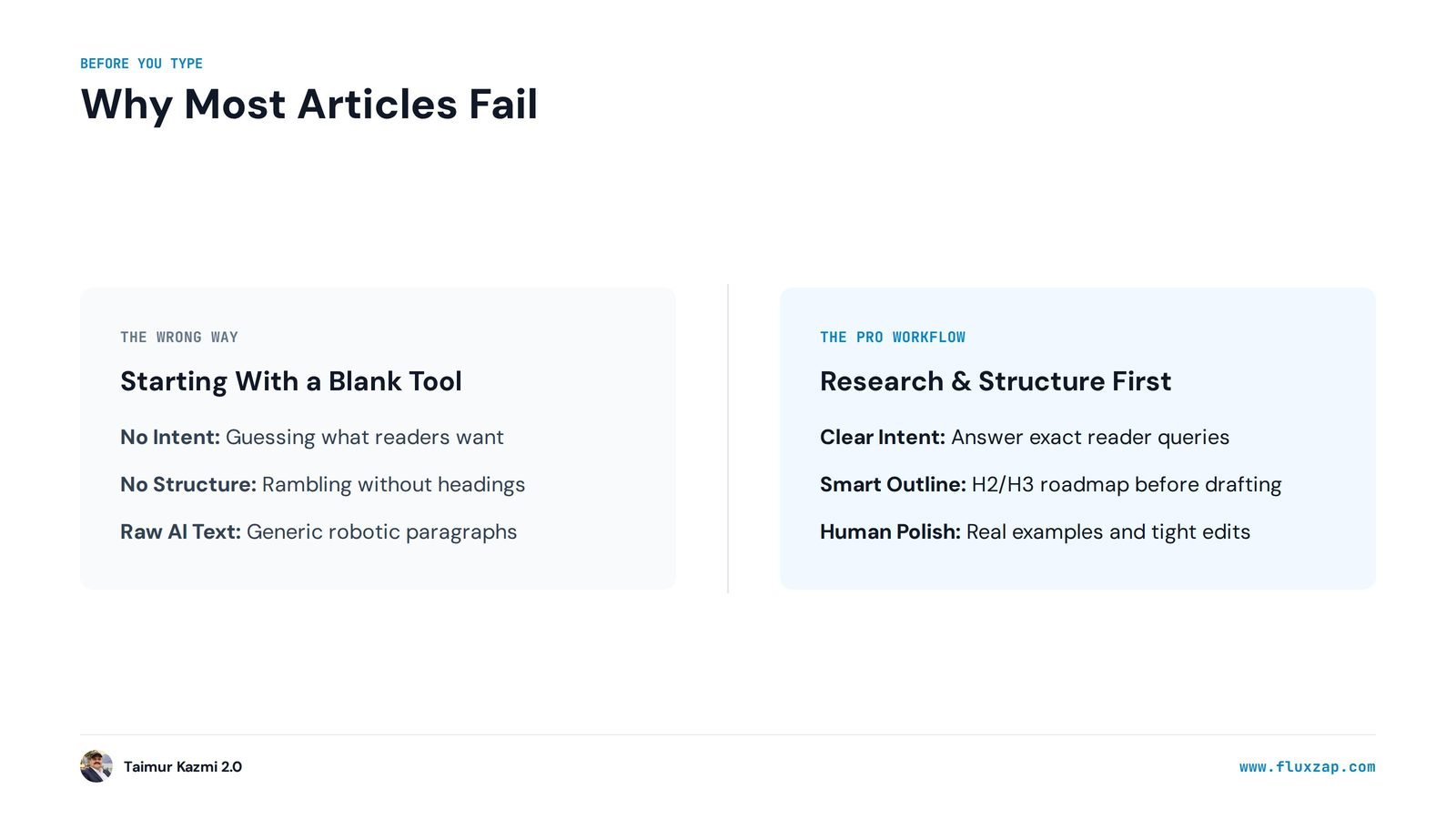
That “blank tool” approach creates three problems at once:
- No intent. You’re guessing what the reader wants instead of answering a real query.
- No structure. The article rambles, with no clear headings or sections.
- Raw AI text. Generic, robotic paragraphs that read the same as 10,000 other pages.
The pro workflow flips the order. You research and structure first, then let AI fill in a skeleton you designed. Then you polish it with real examples and tight edits.
The 5-step framework for AdSense-friendly AI articles
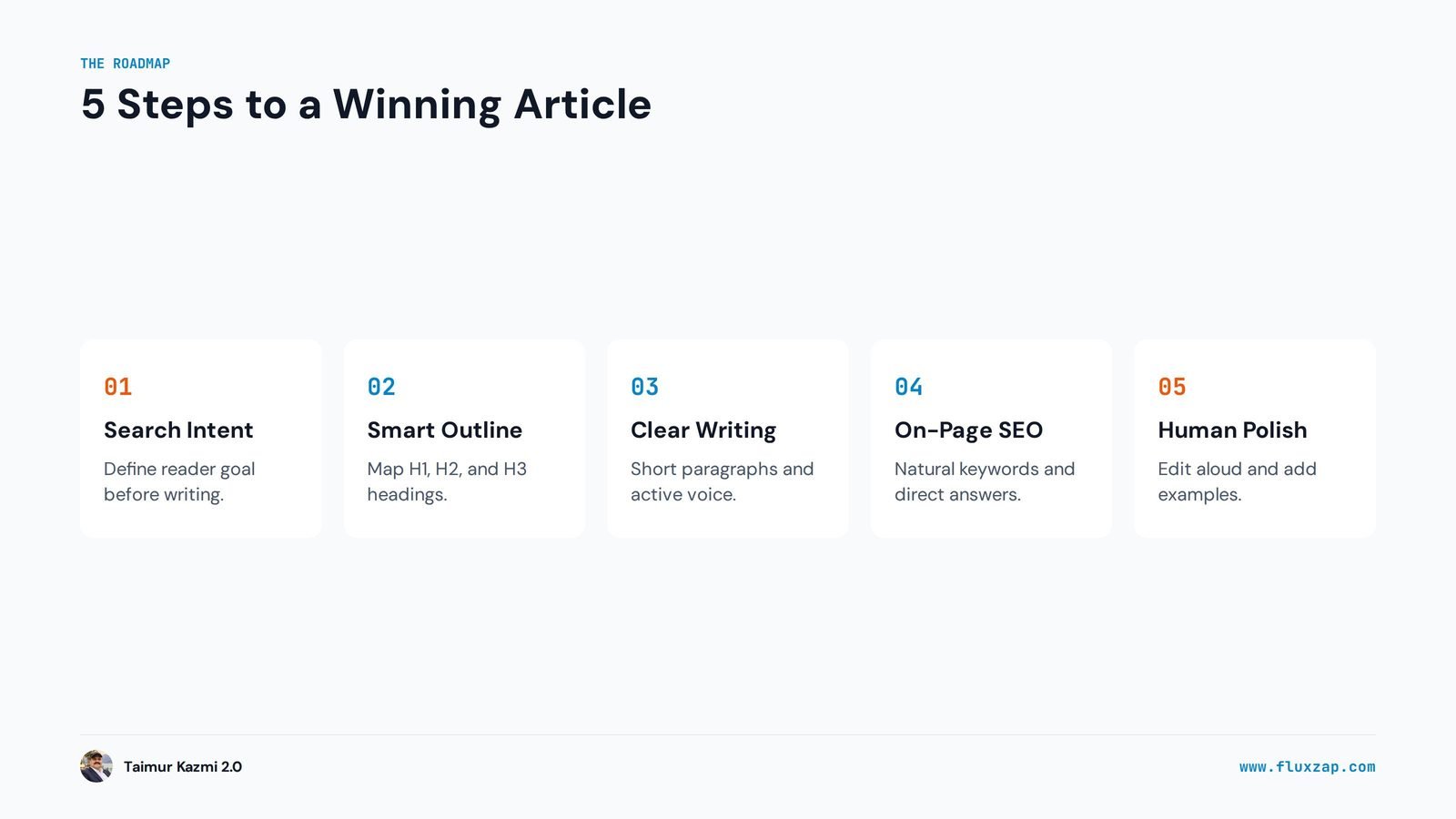
Here’s the whole roadmap at a glance:
- Search intent: define the reader’s goal before writing.
- Smart outline: map your H1, H2 and H3 headings.
- Clear writing: short paragraphs and active voice.
- On-page SEO: natural keywords and direct answers.
- Human polish: read it aloud and add examples.
Let’s break down each one.
Step 1: Nail the search intent with 3 questions
Before you write a single line, answer three questions. If you can’t, the AI can’t either.
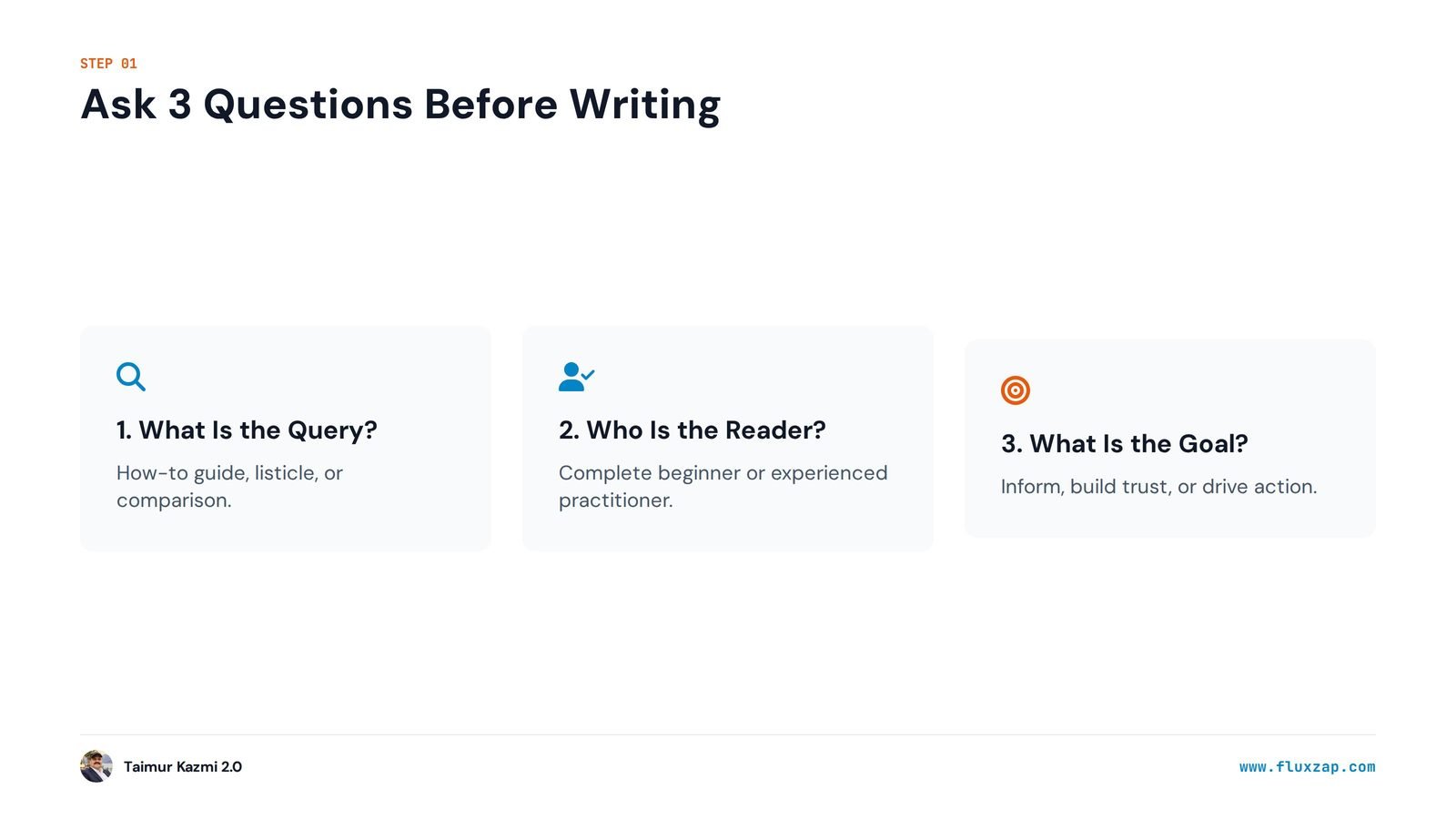
1. What is the query?
Google the keyword and look at page one. Are the results how-to guides, listicles or comparisons? Match that format. If the top 10 results are all step-by-step guides, your opinion essay won’t rank.
2. Who is the reader?
A complete beginner needs definitions and hand-holding. An experienced practitioner wants shortcuts and data. Write for one of them, not both.
3. What is the goal?
Are you trying to inform, build trust or drive an action? Your intro, examples and conclusion all change depending on the answer.
Pro tip: pick low-KD, long-tail keywords. Back in 2013, I ran a small site called flowerborderdesign.com. It had zero backlinks, yet it ranked on Google and earned $300+ a month from AdSense, simply because it answered a narrow query better than anyone else. I sold it on Flippa in 2014. That lesson still holds: a specific question, answered well, beats a broad topic answered generically.
Step 2: Build a smart outline first
An outline is the difference between an AI article that rambles and one that flows. Never ask AI to “write an article.” Give it your outline and ask it to fill in one section at a time.
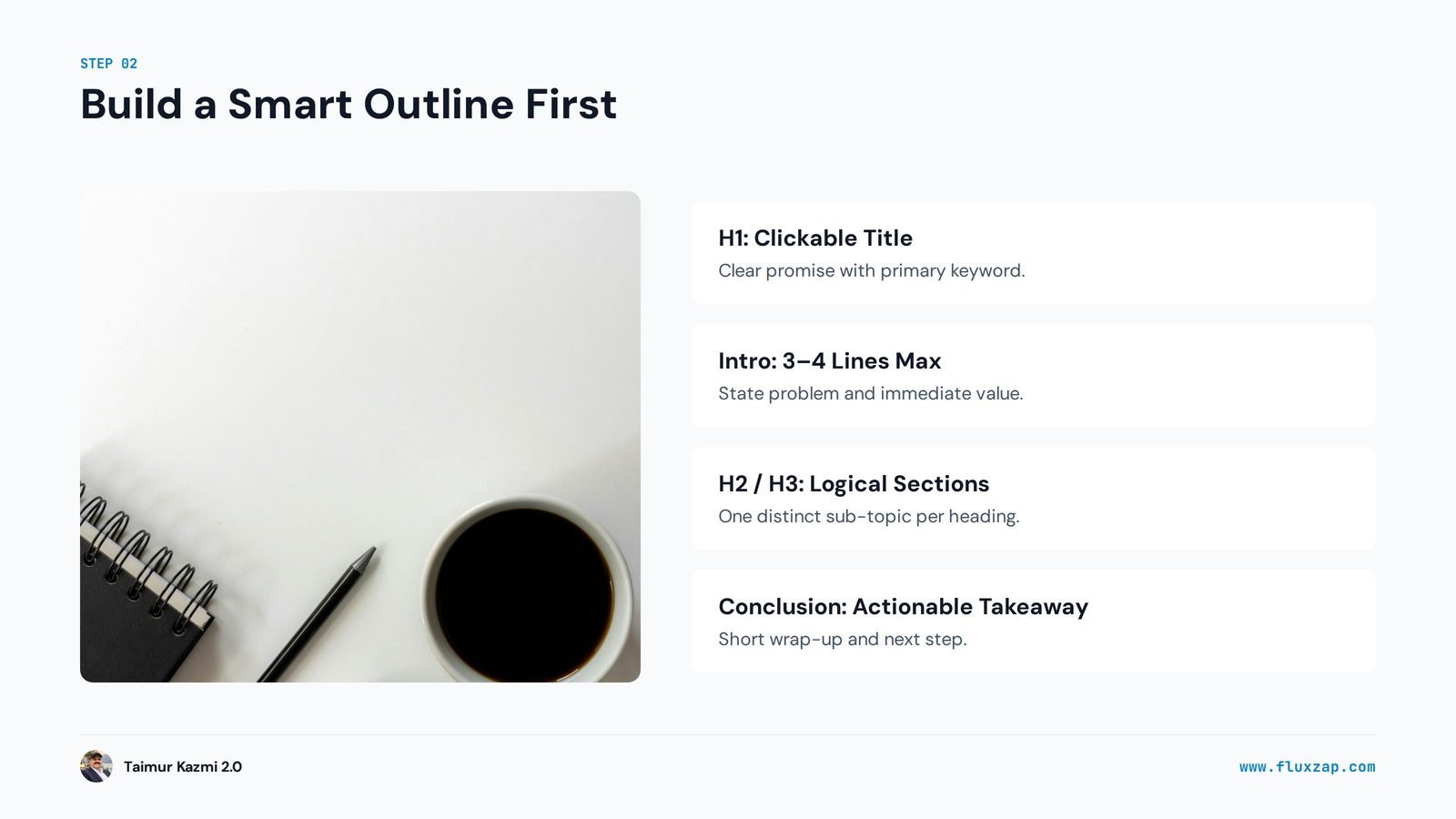
Every article I publish follows this four-part skeleton:
- H1, a clickable title: a clear promise that includes your primary keyword.
- Intro, 3 to 4 lines max: state the problem and the immediate value.
- H2/H3, logical sections: one distinct sub-topic per heading.
- Conclusion, an actionable takeaway: a short wrap-up and a next step.
Here’s a quick test. Read only your headings, top to bottom. If they tell the full story on their own, your outline is ready.
Step 3: Write clearly, because clarity beats complexity
People don’t read web pages. They scan them.
In Jakob Nielsen’s classic study, 79% of test users always scanned any new page, and only 16% read word by word. When the researchers rewrote the same website to be concise and scannable, usability improved by up to 124%. (Nielsen Norman Group)
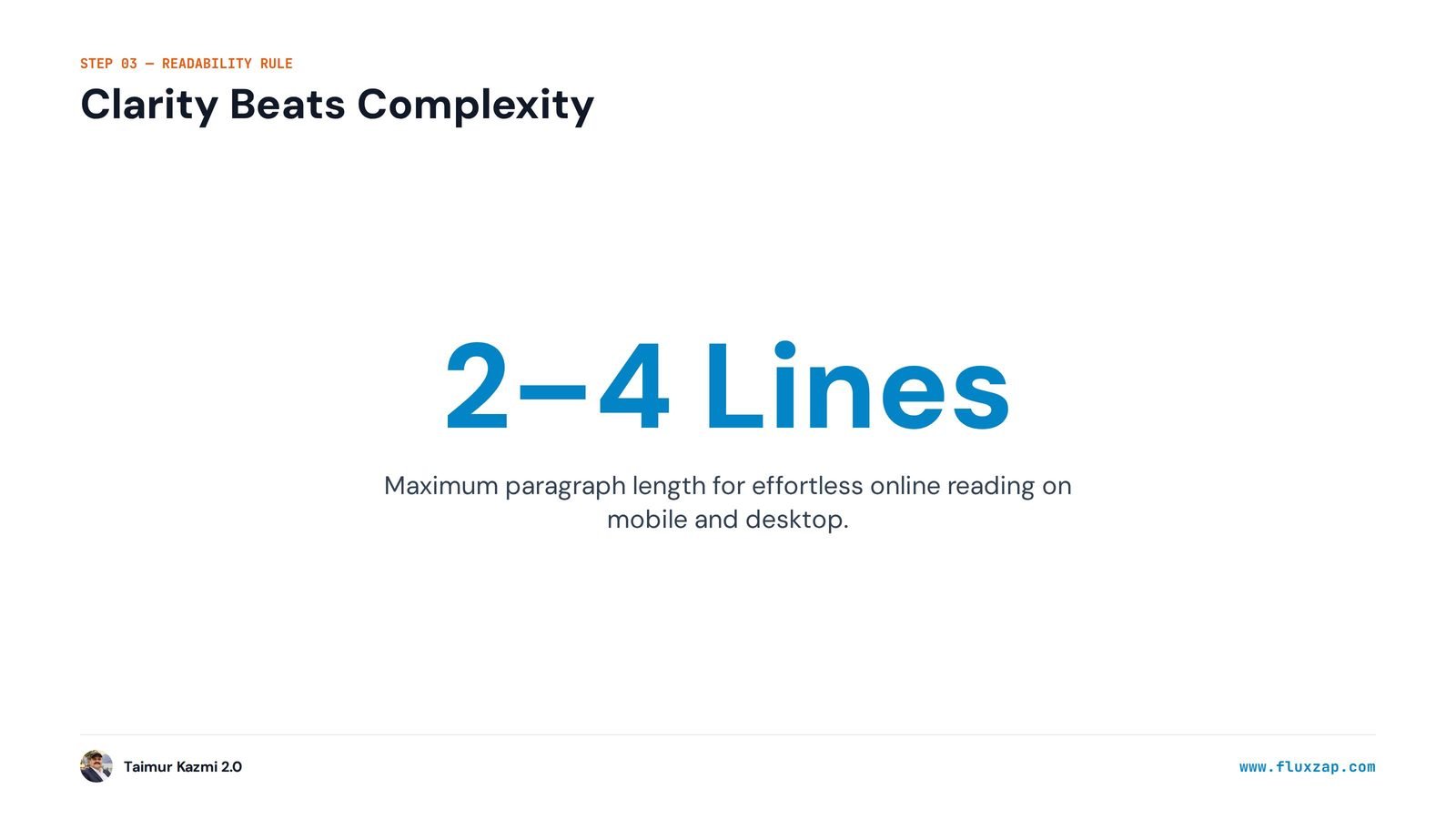
That’s why my rule is simple: 2 to 4 lines per paragraph, maximum. It keeps reading effortless on both mobile and desktop. AI loves long, dense paragraphs. Break them up.
4 rules for high-retention copy
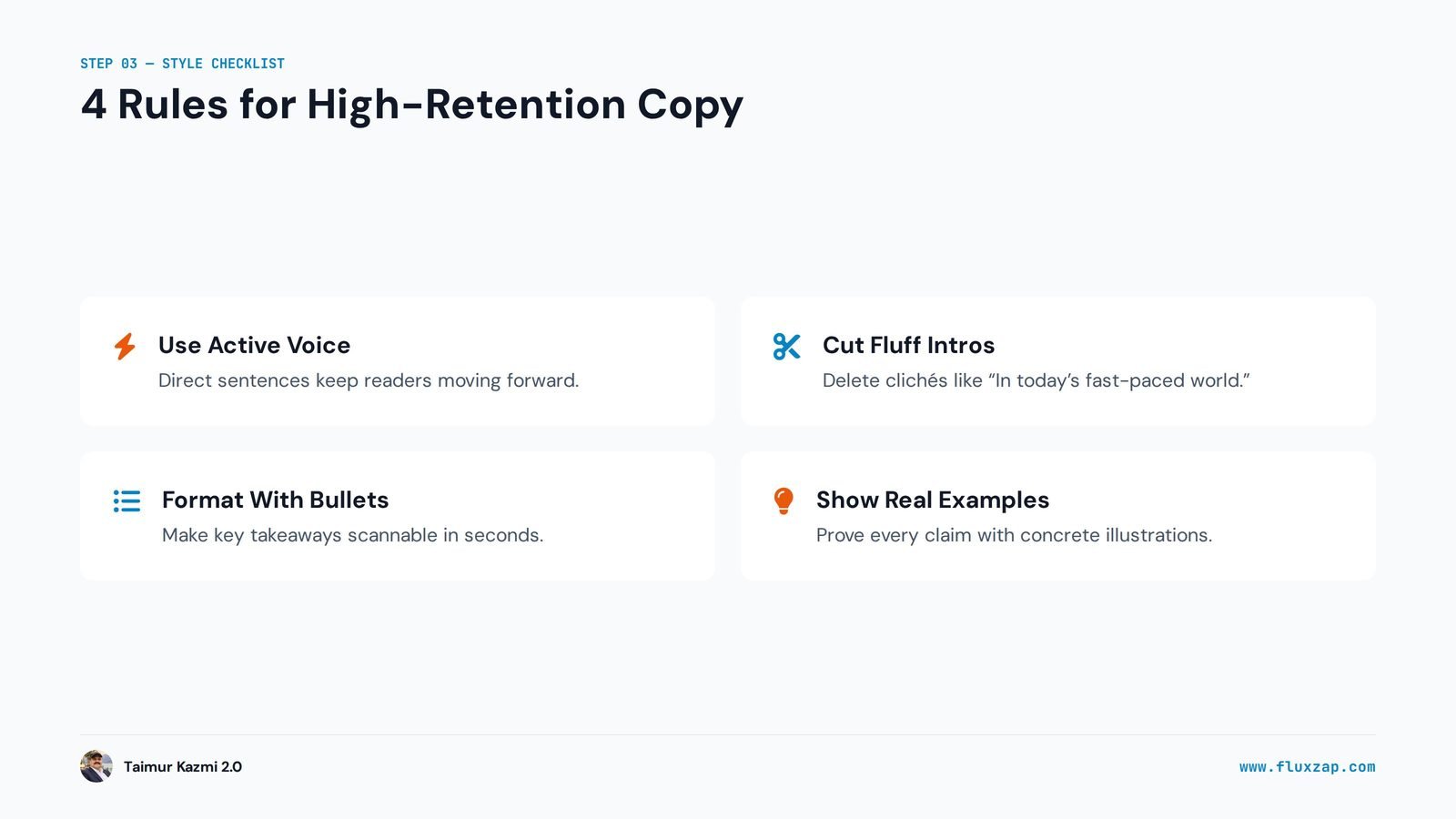
- Use active voice. Direct sentences keep readers moving forward.
- Cut fluff intros. Delete clichés like “In today’s fast-paced world.”
- Format with bullets. Make key takeaways scannable in seconds.
- Show real examples. Prove every claim with something concrete.
Weak vs. strong writing: a live example
Here’s what raw AI output often looks like, next to a human edit of the same idea:
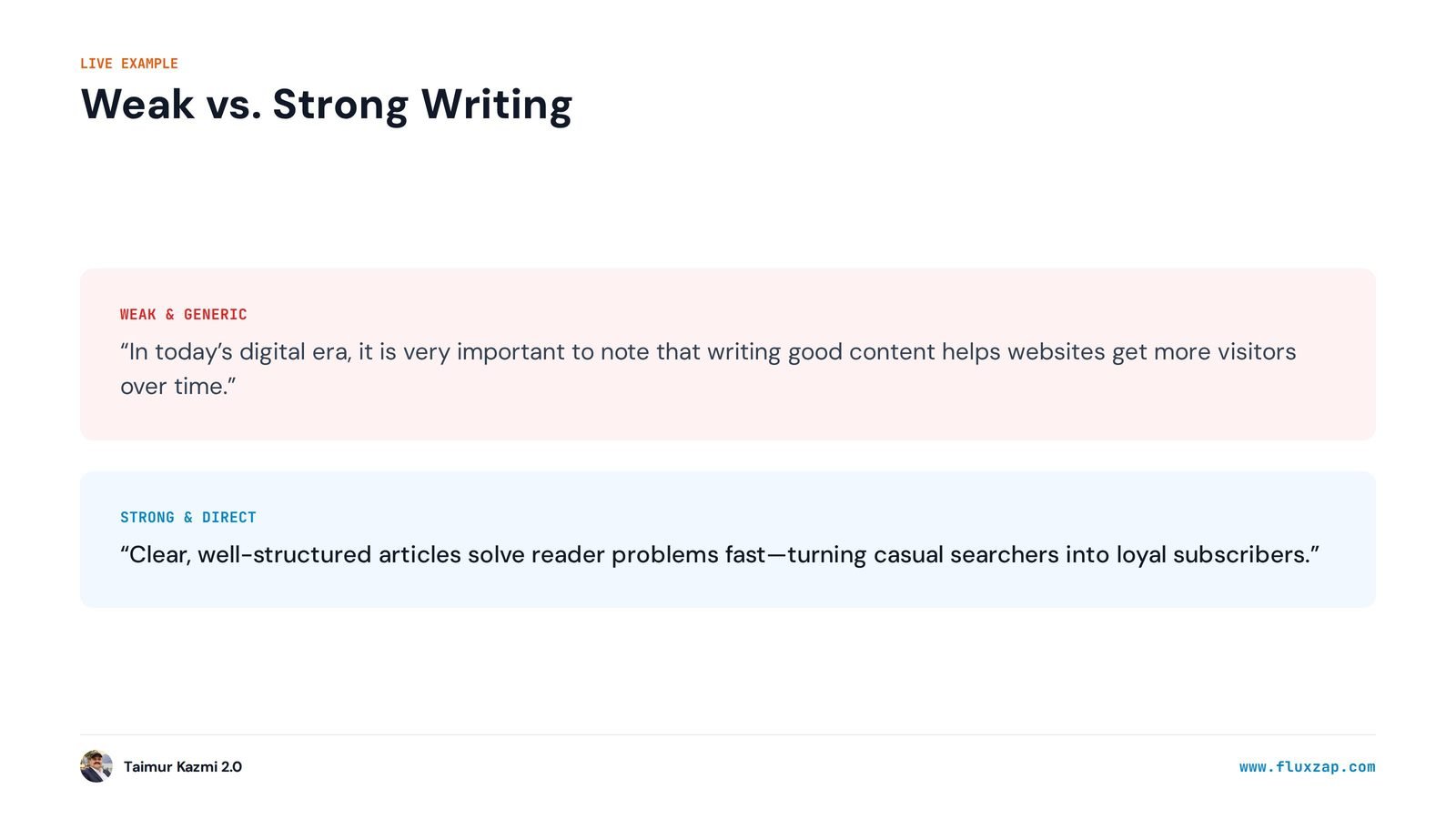
Weak and generic: “In today’s digital era, it is very important to note that writing good content helps websites get more visitors over time.”
Strong and direct: “Clear, well-structured articles solve reader problems fast, turning casual searchers into loyal subscribers.”
The second version is shorter, makes a specific claim and tells the reader what they gain. That’s the edit you’ll make again and again on every AI draft.
Step 4: On-page SEO without keyword stuffing
AI tools tend to repeat your keyword until the text sounds strange. Google notices, and so do readers. Use these four rules instead:
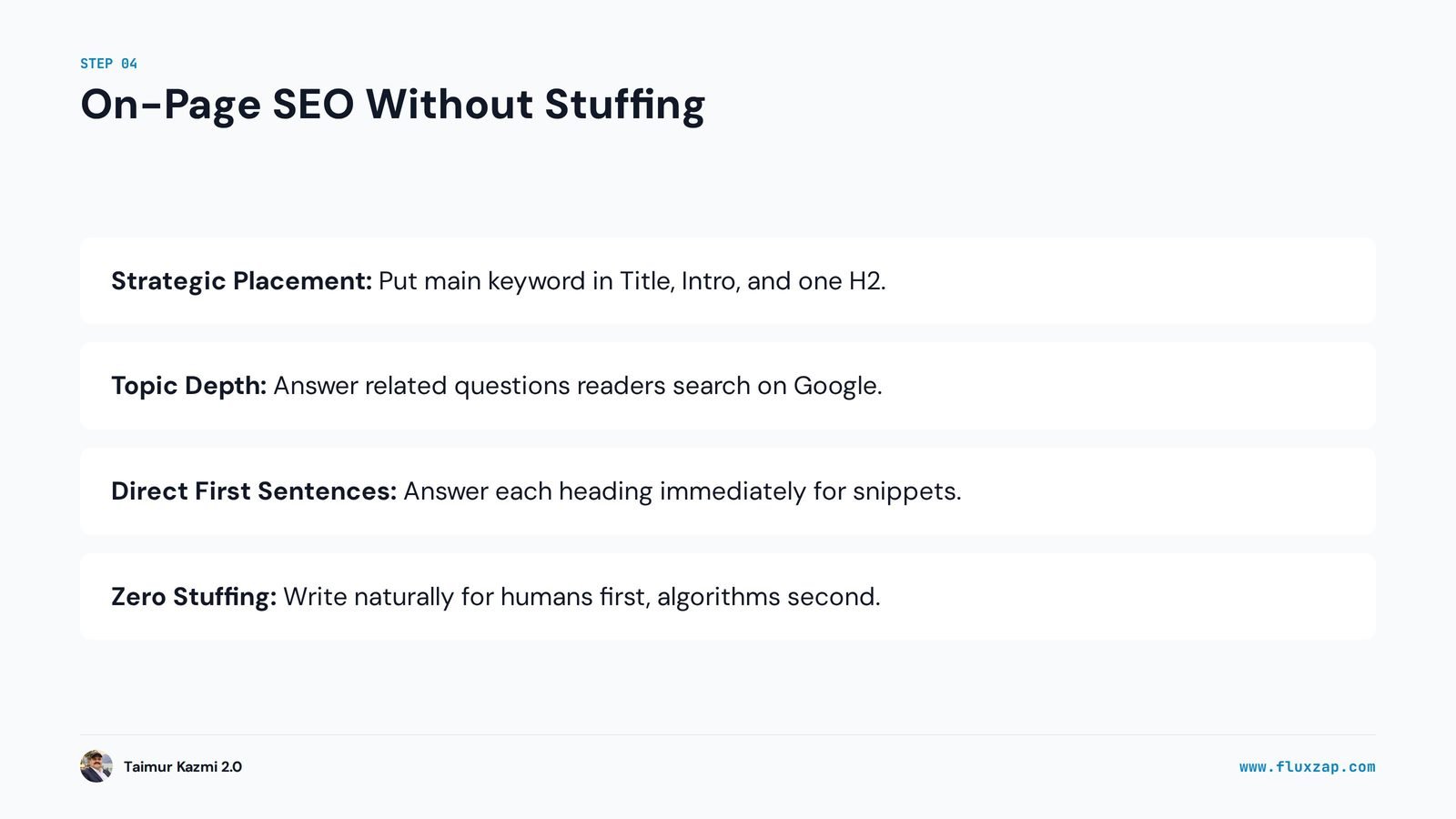
- Strategic placement: put your main keyword in the title, the intro and one H2. That’s enough.
- Topic depth: answer the related questions people search on Google. Check the “People also ask” box.
- Direct first sentences: answer each heading immediately. This is how you win featured snippets.
- Zero stuffing: write naturally for humans first, algorithms second.
Step 5: The human polish checklist
This step is where an AI draft becomes your article. Skip it, and you’re publishing the same text as everyone else using the same prompt.
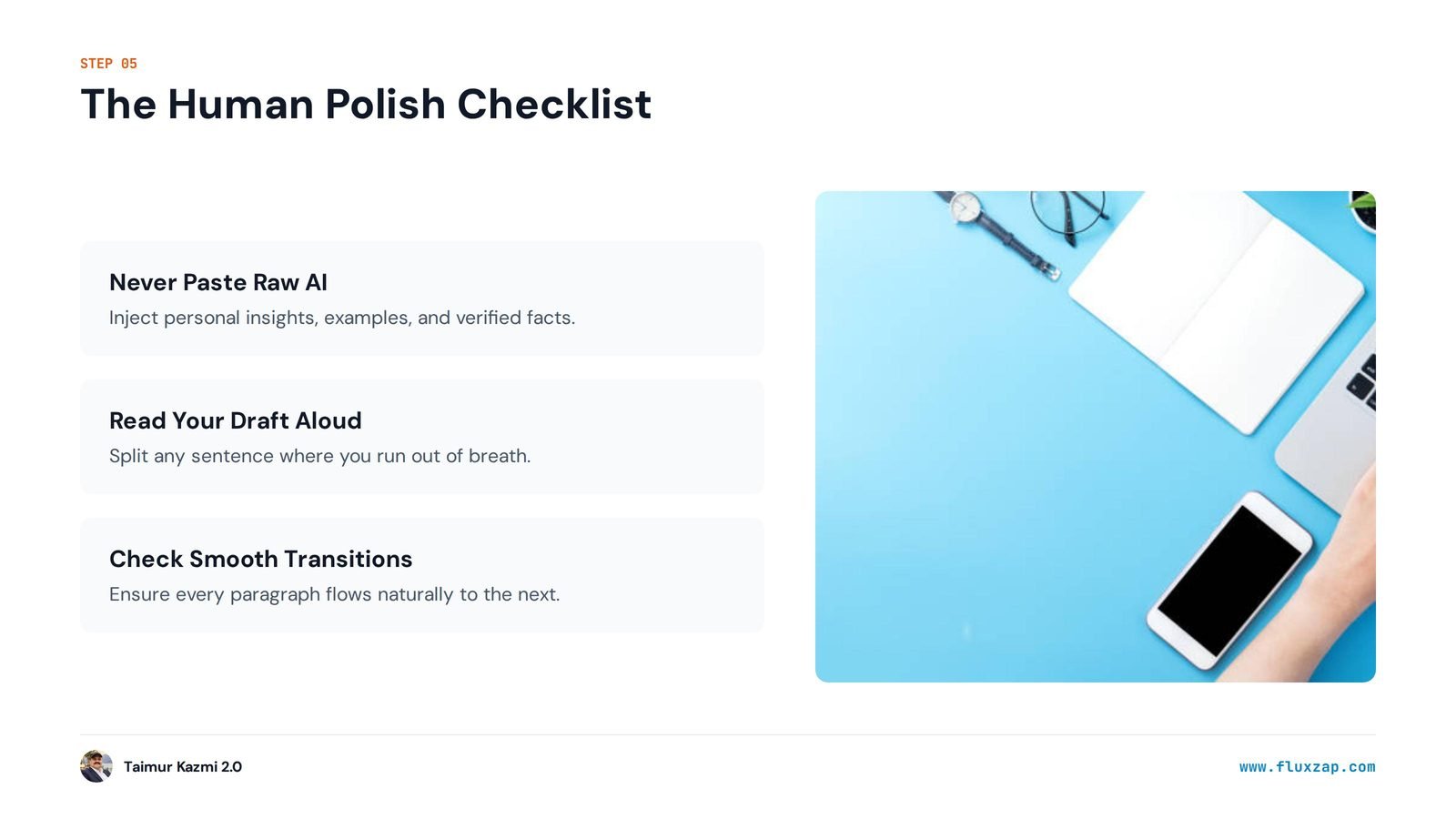
- Never paste raw AI. Add personal insights, examples and verified facts. AI tools can invent numbers, so check every statistic against its source.
- Read your draft aloud. Split any sentence where you run out of breath.
- Check smooth transitions. Make sure every paragraph flows naturally into the next.
Google’s own guidance asks you to consider the “Who, How and Why” of your content: who created it, how it was made and why it exists. If the honest answer to “why” is “to rank,” you have a problem. If it’s “to help someone solve X,” you’re on the right track. (Google: Creating helpful, people-first content)
Quick summary: your article formula
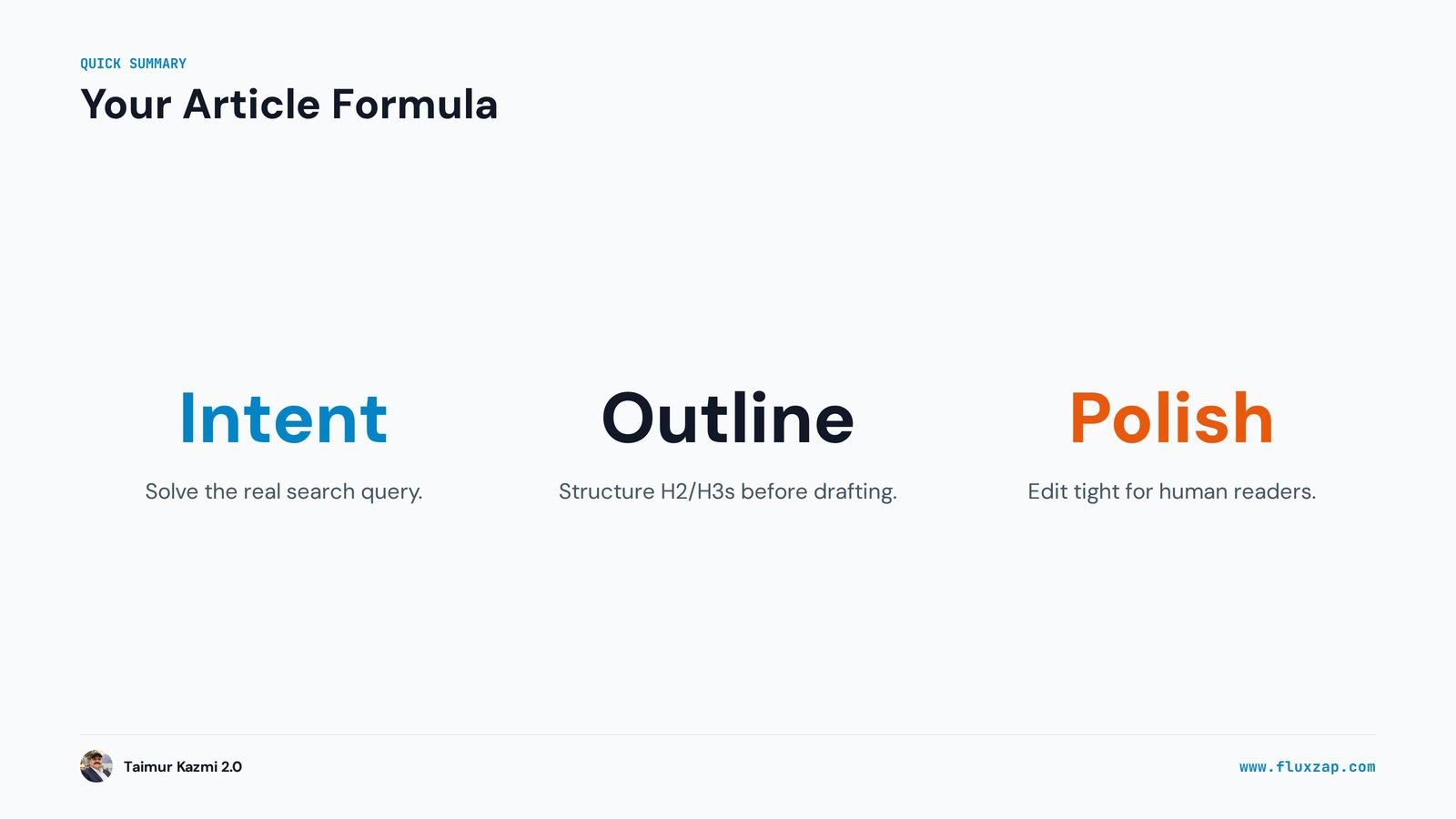
If you remember nothing else, remember these three words:
- Intent: solve the real search query.
- Outline: structure your H2s and H3s before drafting.
- Polish: edit tightly for human readers.
FAQ
Can I get AdSense approval with AI-written articles?
Yes, if the articles are genuinely useful. Google judges content quality, not how the content was produced. Raw, unedited AI text is what usually triggers the “low value content” rejection.
How long should each paragraph be?
Two to four lines. Most readers scan, and short paragraphs make your page easy to read on a phone.
How many times should I use my main keyword?
Put it in the title, the intro and one H2. After that, cover related questions and synonyms naturally instead of repeating the same phrase.
Conclusion
“Low value content” isn’t a verdict on AI. It’s a verdict on lazy workflows. Define the intent, build the outline, write clearly, optimize lightly, then polish like a human. Do that for every article, and AI becomes your fastest writer instead of your biggest risk.
Your turn: copy the four-part outline from Step 2 and use it as a free template for your next article. Then tell me your niche in the comments. I’ll pick one and do a live article breakdown in the next video on the Taimur Kazmi 2.0 YouTube channel.