

YouTube algorithm 2026 : YouTube’s Most Critical Window Has Shrunk
On YouTube today, success or failure is often decided before a viewer settles in. The first 30 seconds of a video now play a decisive role in how far that content travels. Whether a video reaches 1,000 views or 1 million increasingly depends on what happens immediately after the play button is pressed.
This shift is driven by how the YouTube algorithm evaluates early viewer behavior, retention signals, and satisfaction metrics in real time—an evolution explored in detail in our breakdown of how YouTube’s recommendation system works FluxZap YouTube algorithm guide).
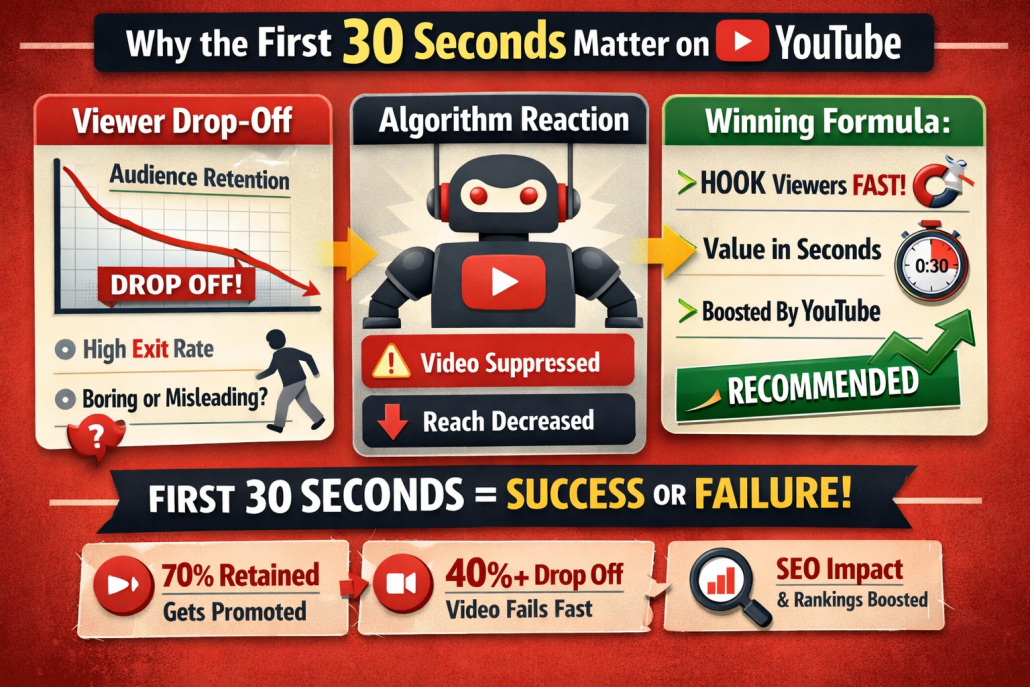
Why the First 30 Seconds Matter More Than Ever
YouTube’s recommendation system is built around one primary goal: maximizing viewer watch time across the platform. To achieve this, YouTube aggressively measures early engagement signals.
Within the first 30 seconds, YouTube tracks:
- Audience retention
- Immediate drop-off rate
- Watch continuation
- Satisfaction signals
- Alignment between title, thumbnail, and content
If viewers leave early, YouTube interprets the video as low-value or misleading—and distribution slows almost instantly.
This behavior aligns with insights shared by the YouTube Creator Insider team, which regularly explains how early retention influences recommendations. Youtube.com/@CreatorInsider
The Data Behind the Claim
Multiple creator analytics studies reveal a consistent pattern:
- Videos retaining 70% or more viewers in the first 30 seconds are far more likely to:
- Appear on the Home feed
- Be promoted in Suggested Videos
- Rank faster in YouTube Search
- Videos losing 40–50% of viewers early rarely recover—even if the remaining content is strong
How the Algorithm Interprets the First 30 Seconds
1. Viewer Intent Validation
YouTube checks whether the video delivers what the title and thumbnail promise. A mismatch leads to exits—and immediate suppression.
2. Engagement Prediction
Early behavior helps YouTube predict:
- Will viewers finish the video?
- Will similar audiences enjoy it?
- Is this content scalable?
3. Satisfaction Signals
While likes and comments help, staying matters more. Passive retention is one of the strongest quality signals today.
The Biggest Mistakes Killing Videos in the First 30 Seconds
Many creators unintentionally damage performance by:
- Using long branded intros
- Repeating the video title verbally
- Delaying the main value proposition
- Opening with low-energy delivery
What High-Performing Videos Do Differently
Successful videos follow a consistent opening structure:
Immediate Hook (0–5 seconds)
A bold statement, strong visual, or surprising claim.
Value Confirmation (5–15 seconds)
A clear explanation of what the viewer will gain.
Momentum Building (15–30 seconds)
A smooth transition into the core content without filler.
Marketing analysts at platforms like Tubefilter and VidIQ regularly highlight this structure as a best practice.
VidIQ blog on audience retention
Proof from YouTube Shorts and Long-Form Content
The rise of YouTube Shorts has reshaped viewer expectations:
- Shorts demand engagement within 1–3 seconds
- Long-form videos are now judged with similar urgency
- Viewer patience has declined across all platforms
SEO Impact: Why Early Retention Affects Rankings
Early retention influences:
- Faster indexing
- Higher keyword rankings
- Increased visibility in Suggested Videos
In short: Retention drives reach, and reach strengthens SEO—a principle central to FluxZap’s content strategy.
For confirmation, Google-owned YouTube acknowledges that watch time and satisfaction signals influence search rankings. Google Search Central – Video SEO guidelines
How to Optimize the First 30 Seconds (Actionable Framework)
- Script the hook before the rest of the video
- Remove all unnecessary words
- Match the opening frame to the thumbnail
- Use visual pattern interrupts
- Preview the outcome clearly
Example: Weak vs Strong Opening
Weak:
“Hey guys, welcome back to my channel…”
Strong:
“Most YouTube videos fail in the first 30 seconds—and the algorithm decides instantly.”
The difference directly affects retention and algorithmic trust.
Why This Matters for Businesses and Publishers
For platforms like FluxZap, YouTube is more than a video platform—it’s a long-term discovery engine.
Failing to optimize early engagement results in:
- Lost organic reach
- Lower ROI on content production
- Missed brand authority opportunities
This is why early retention should be treated as a core performance metric, not an afterthought.
Final Takeaway
On modern YouTube, content is judged instantly. The first 30 seconds are no longer an introduction—they are a filter.
Creators and publishers who master this window earn visibility, authority, and sustainable growth. Those who don’t are quietly sidelined by the algorithm.
On YouTube, attention is the currency—and the first 30 seconds decide who gets paid.


